Takeaways from content we’ve enjoyed & other timely topics
From Outcomes to Inputs
We’re halfway through January, and goal setting is in full swing. At work and at home, we tend to frame our goals around outcomes: earning the promotion, hitting a sales target, building muscle, running a faster 10K.
Those outcomes matter. They give us direction. But on their own, they’re not very useful in deciding what to do day to day, tracking progress along the way, or adapting when things don’t go as planned. To make progress, we need more than a destination. We need to chart a path to reach it.
One framework we’ve found particularly helpful comes from The Four Disciplines of Execution (4DX), which makes an important distinction between lagging and leading metrics.
Lagging vs. Leading Metrics
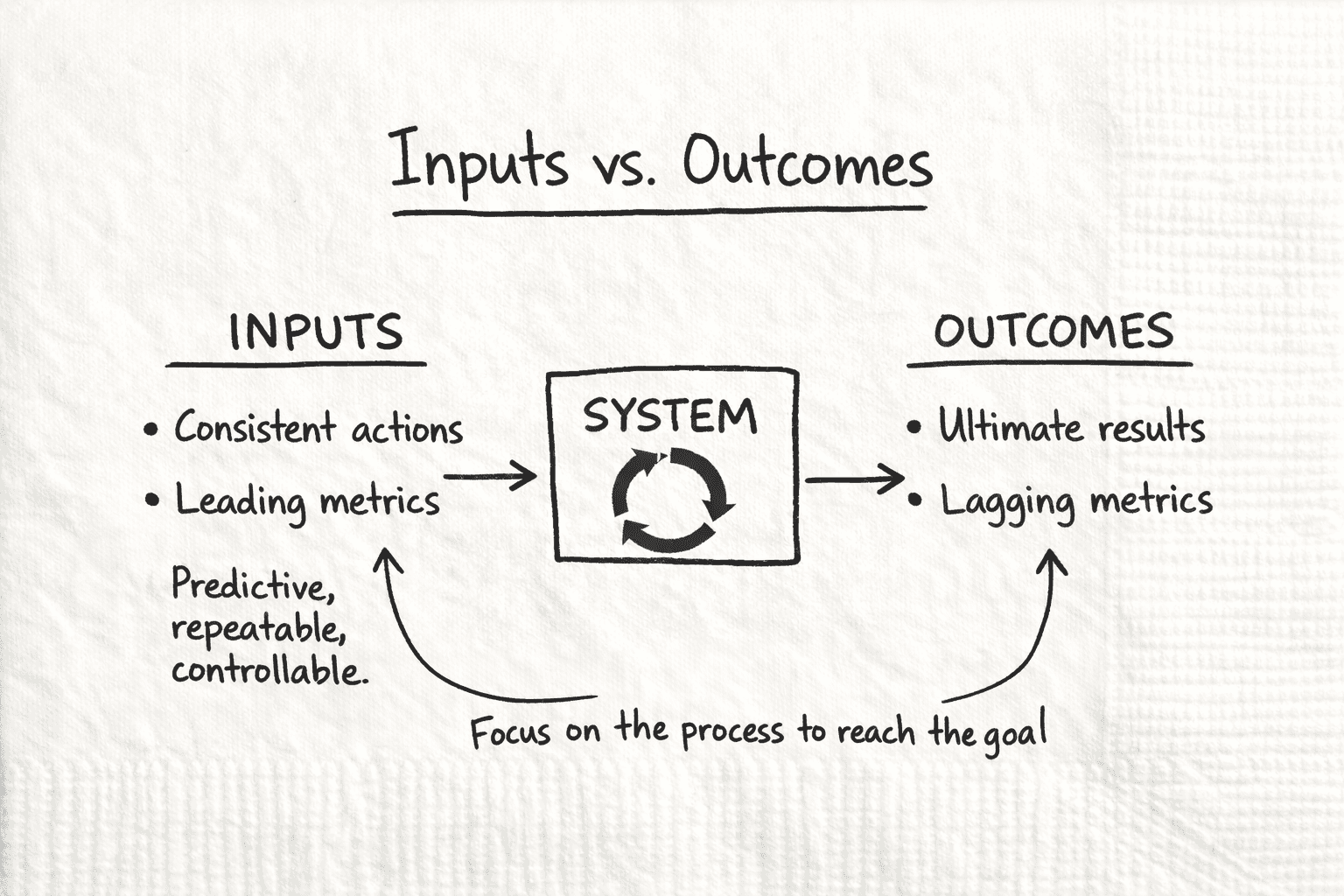
Lagging metrics reflect results. In business, that might be revenue or customer growth. In health, it could be body composition, aerobic fitness, cholesterol levels, or strength. These metrics are critical. They tell you where you ended up at the end of a defined period. The challenge is that by the time you measure them, the behaviors that produced them are already behind you.
Leading metrics measure the actions that make those results more likely. In the business world, think: number of weekly sales calls or content pieces published. For your health, this may be: number of workouts per week, consistent early bedtimes, food logging. These are the small, repeatable inputs that drive the target results over time.
Leading metrics should meet a few conditions:
They're predictive: You’re confident that doing them consistently will drive the desired outcome.
They're repeatable: They’re tracked frequently, often daily or weekly, and you refine them as you learn along the way.
They're controllable: Whether you hit these or not is largely based on your own actions.
Lagging metrics tell you whether your strategy worked. Leading metrics tell you whether you’re doing the right things now to achieve success.
Managing What You Can Control
Where 4DX becomes especially useful is in how it shifts your focus day to day. You can’t actively manage a lagging metrics in the moment. You can only react to it after the fact. Fixating on outcomes alone can create uncertainty and frustration, because they move slowly and can’t be changed on demand.
Leading metrics, by contrast, offer immediate feedback. They’re the tangible actions you can choose, or skip, each day. That doesn’t mean abandoning outcome goals. It means using them as direction vs. fixation.
A helpful mental shift is this:
Use lagging metrics to set direction and evaluate progress
Use leading metrics to guide daily decisions and behaviour
We think about this a lot at Benchmark. It’s at the core of how we build our assessment programs, and how we help our members set achievable goals. Assessments, by design, tend to focus on lagging metrics: lower HbA1C, higher lean mass, lower resting heart rate. But when we examine these along with the drivers behind them (daily glucose control, early bedtimes, frequent movement, strength workouts), we unlock a deep understanding and personal awareness that can drive lasting change.
As we’ve discussed before, achieving our goals depends on a system of habits. As James Clear put it, “fix the inputs, and the outputs will fix themselves.”
As you set your goals this year, don’t just think about what you want to achieve. Ask yourself, what are the few actions I can take today that will make my desired outcome far more likely?